Urban project - Cidade
Universitaria de Lisboa
For Urban project III we worked in 3 phases. In the first phase we conducted a general analysis of the accessability of the campus and we registered what the different functions were on campus. This data we then compared to the situation of other campusses that we are familiar with.


Tessaloniki:


Athens:


Brussels:


Lisbon:
During the second phase we put the focus on the "Cidade Universitaria de Lisbon" and made a tural analysis of the different functions it provides and the relationship of the campus internally and with it's surrounding. The aim of these analysis was to expose the strengths and weaknesses of the public space and the relationships it has with the different faculties, the accessibility and the neighborhood, but also which opportunities and threats there are towards the future of the Cidade Universtaria de Lisboa (SWOT analysis). To help find out these threats we made a comparison with university campuses we knew personally.




The biggest problems we saw where:
-
The dominance of the car on campus.
-
A lack of biking facilities
-
A monoculture of functionality
-
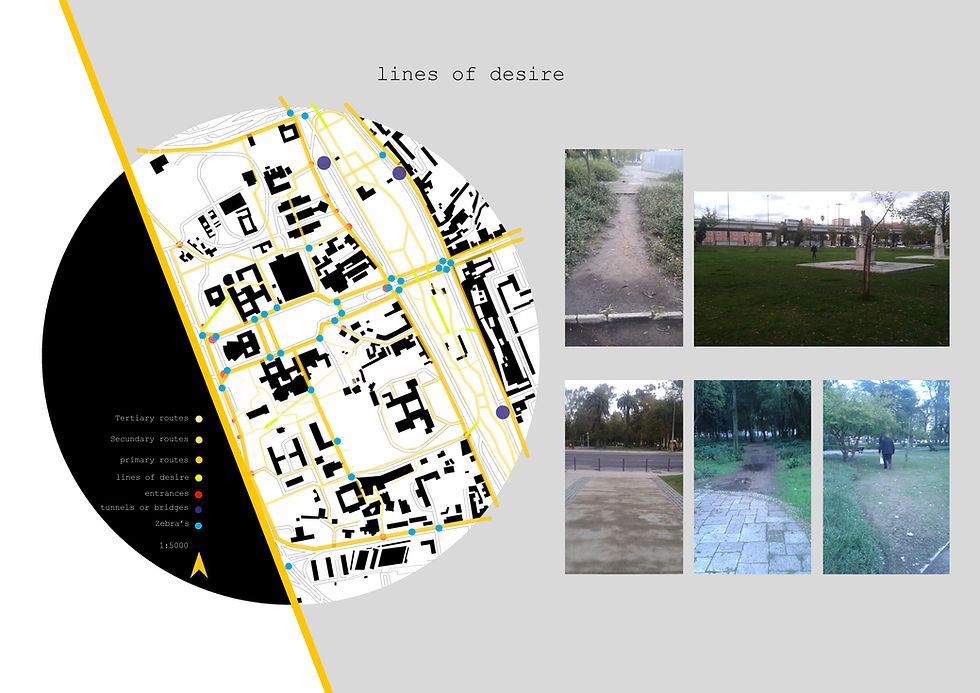
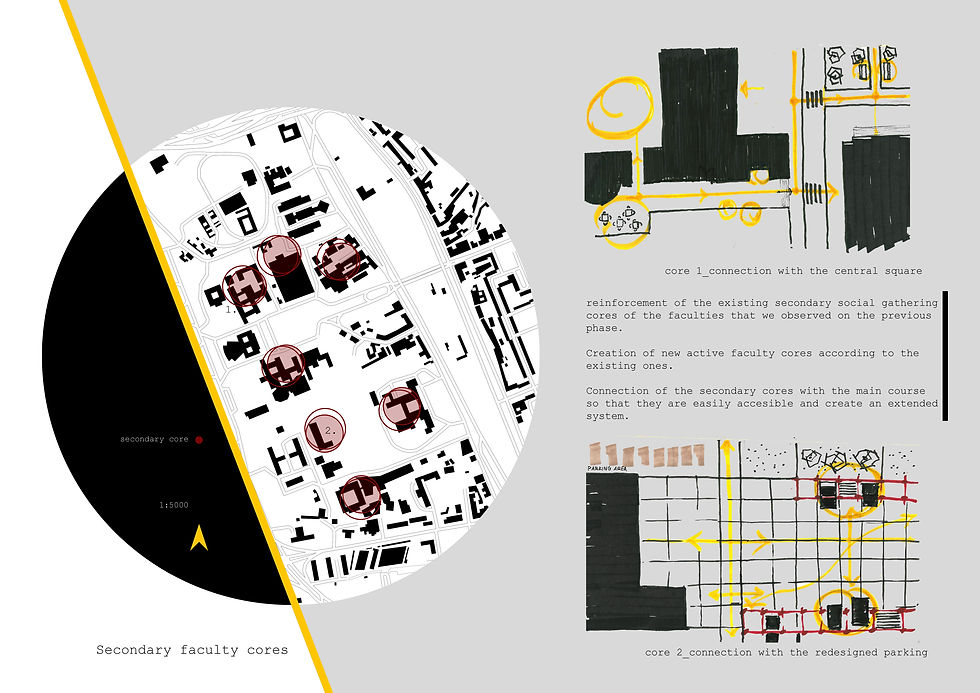
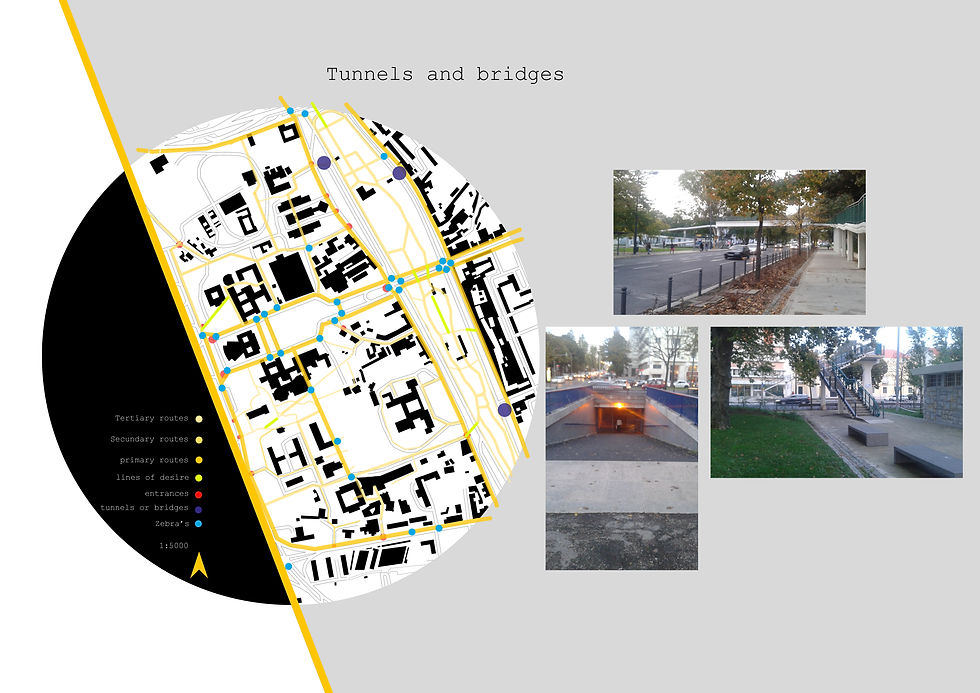
No or little connectivity of the different faculties and public spaces.
The Dominance of the car
In the current situation the car dominates the central lanes of the campus connecting west with east, but also the north-south axis is taken over by the car since the main parking is located in the middle of this axis.
It would be hard to change the traffic on the east- west axis, since this is the only way to get from Campo Grande to the Reitoria and the av. Prof Gama Pinto and the other way around. The North- South axis on the other hand can be modified quite easily. With a circulation plan which uses the first part of Av. Anibal Bettencourt and a road passing behind the library and ends at Rua dr Joao Soares, the north- south axis can become car free quite easily. This would create a pedestrian area that starts at Iscte and ends at Alameda de Universidade. This would benefit the connectivity between the different faculties and it would also open up space for bike lanes and for more green as part of the public space.
A lack of biking facilities
You can find bike stands on campus and there is a bike repair shop as part of the faculty of science as well, but these facilities are highly under used. We see the topography of Lisbon as a part of the problem. That’s why we propose a bike rental system that is closely linked to the public transport. This way you can easily continue your journey after leaving the Metro, bus,… to your end destination. Once arrived, you leave the bike in the therefor foreseen bike stands where it becomes available for someone else. With this system you become a lot more mobile on campus during the day and a lot more flexible in how you come to campus since the time between any given points is drastically decreased. So we again raise the connectivity of the different faculties on campus, but we also discourage the use of the car.
A monoculture of functionality
One of our biggest concerns was the highly academic function of the campus. Don’t get me wrong, it’s good for a University City to have an academic character, but this should not be its only purpose. Students should be able to engage with each other outside or within the academic context. That is why we would like to build a modular structure instead of the parking area.
This modular structure would be part of a park with an atrium. The initial parking spots will be placed underground and this would complete our circulation plan for the car.
The idea of the modular structures (kind of containers) is that you can shape them according to your needs.
-
If you need a workspace for your project, you can use 1 unit for that.
-
If you have a group meeting you can move 2 or 4 units together to create a bigger space.
-
If you want to have a band practice you can use 6 or 8 units.
-
Or if you want to organize a party you can put them all together and create 1 big room.
By creating a place in the middle of campus where people can come together and exchange ideas, be creative,… and by placing it next to the central pedestrian area we hope to start a creative hub and a place of which the attraction will go beyond the borders of the campus.
We are convinced that this would also benefit the little bars that are located in and around the different faculties since you will create a contrast between the intimate setting of the atria a the busy character of the park.
No or little connectivity of the different faculties and the open spaces.
This topic is a bit the common thread of the story. And the solutions given above already improve this connectivity a lot.
We created the creative hub and meeting spot on the present parking, but we still have a highly dysfunctional central placa in front of the Reitoria da Universidade de Lisboa.
This square is highly underused and since there are two busy roads surrounding the square it is hard to give it a greater functionality. It becomes a bit of an island on campus. But that’s where the opportunities lie. Instead of an Island, we can make it a resting point in the heart of the campus and improve its functionality as the meeting point, by making it literally the crossroad between the different faculties. But we should also add more green to the area as counter weight to the polluting cars surrounding the square. By doing so and together with all the other measurements, we give back the oxygen to the Cidade Universitaria de Liboa and the people in it that they so badly need.